NACA and Census Tracts: Why the Address Can Change Your Rate

By Martin Kurylowski, REALTOR® · Thursday, October 22 · 7 min read
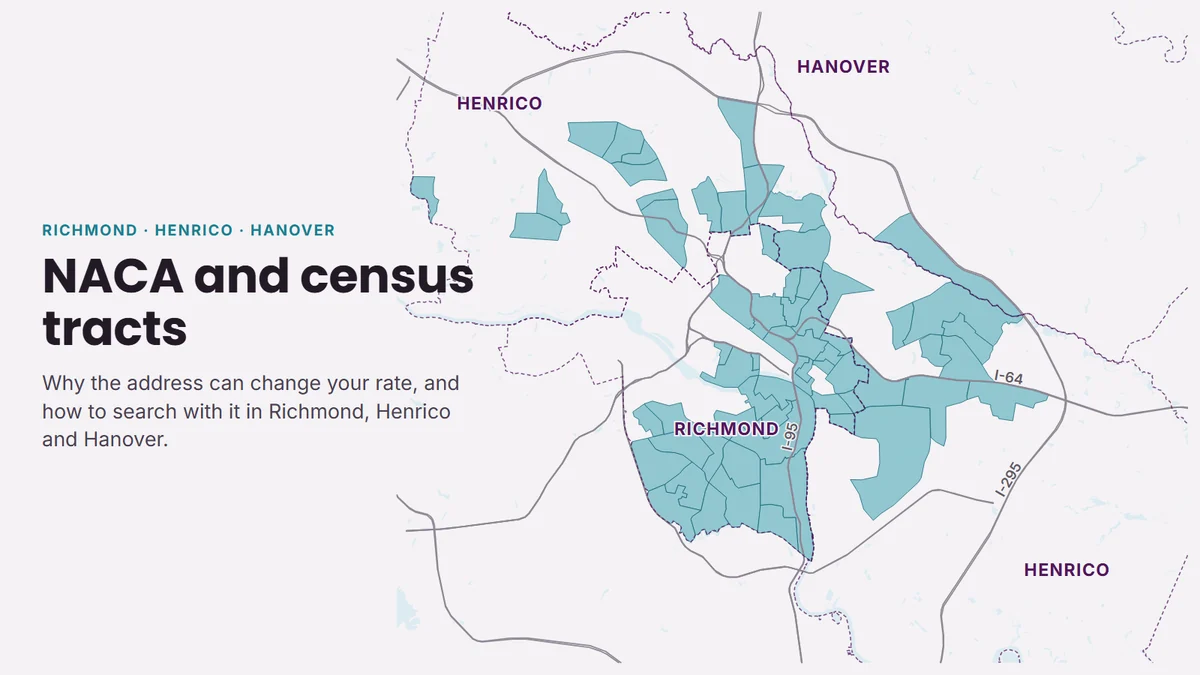
Most people think about NACA in terms of the buyer: your savings, your payment history, your budget. But one of NACA's rules is about the house. More precisely, it's about the census tract the house sits in.
For some buyers, the tract has no effect at all. For others, it decides whether they get NACA's extra rate discount, and above a certain income it limits where they can buy through NACA. If you're in one of those groups, the tract belongs at the start of your home search, not the end.
I bought my first home through NACA (here's that story). These days I screen every home I send a NACA buyer against the tract map, because it's an easy thing to miss and an expensive one to get wrong.
Want to check an address right now? Use the free NACA census tract check. Nothing you type is saved.
What a census tract is
The Census Bureau divides every county into census tracts: small areas of a few thousand residents each, drawn mostly along streets, rail lines and rivers. Each tract gets a median household income from Census survey data.
The Federal Financial Institutions Examination Council (FFIEC) then compares each tract's median income with the median for the whole metro area and gives the tract a level:
| FFIEC level | Tract median income vs. metro median |
|---|---|
| Low | Under 50% |
| Moderate | 50% to under 80% |
| Middle | 80% to under 120% |
| Upper | 120% or more |
Banks use these levels for Community Reinvestment Act reporting. NACA uses them to decide where its location-based rate benefit applies.
How NACA uses the tract
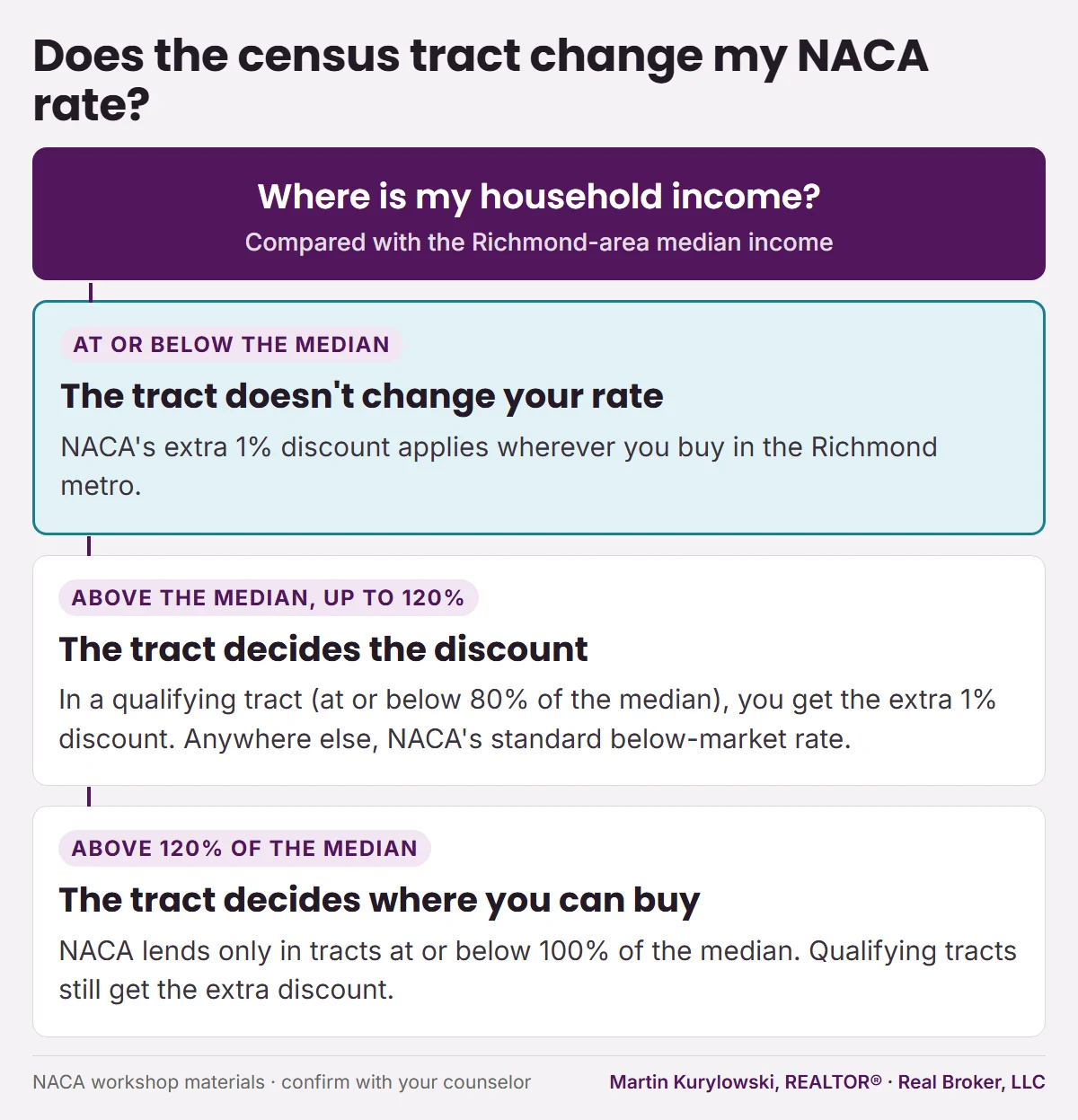
NACA's workshop lays out the rule in three brackets, based on your household income compared with the metro median:
| Your household income | Where the home is | What it means |
|---|---|---|
| At or below 100% of the metro median | Anywhere in the metro | You get NACA's extra 1% discount wherever you buy. The tract doesn't change your rate. |
| Above 100% | A tract at or below 80% of the metro median (Low or Moderate) | You get the extra 1% discount. |
| Above 100% | Any other tract | You can still buy with NACA, at NACA's standard below-market fixed rate. |
| Above 120% | Only tracts at or below 100% of the metro median | That's where NACA lets you buy. |
So the tract matters most for buyers above the metro median income. For them, two houses at the same price can come with different rates depending on which side of a tract line they sit.
A lower rate also means a lower payment for the same loan amount. Since NACA approves you for a monthly payment, not a price, that discount can change what fits within your approval.
Your NACA counselor decides which bracket you're in, so ask in your first counseling sessions. For a rough idea beforehand, the FFIEC's 2026 estimated median family income for the Richmond area is $113,100, and the tract check can estimate your bracket without saving anything you type.
What this looks like around Richmond
| Richmond City | Henrico | Hanover | |
|---|---|---|---|
| Census tracts | 75 | 85 | 25 |
| Qualifying tracts (Low or Moderate) | 41 | 26 | 1 |
| Neighborhoods or subdivisions split by a tract line | 15 of 92 city planning neighborhoods | 29 of 352 subdivisions | n/a |
FFIEC 2024–2026 tract levels; Census TIGER 2020; City of Richmond and Henrico County parcel records.
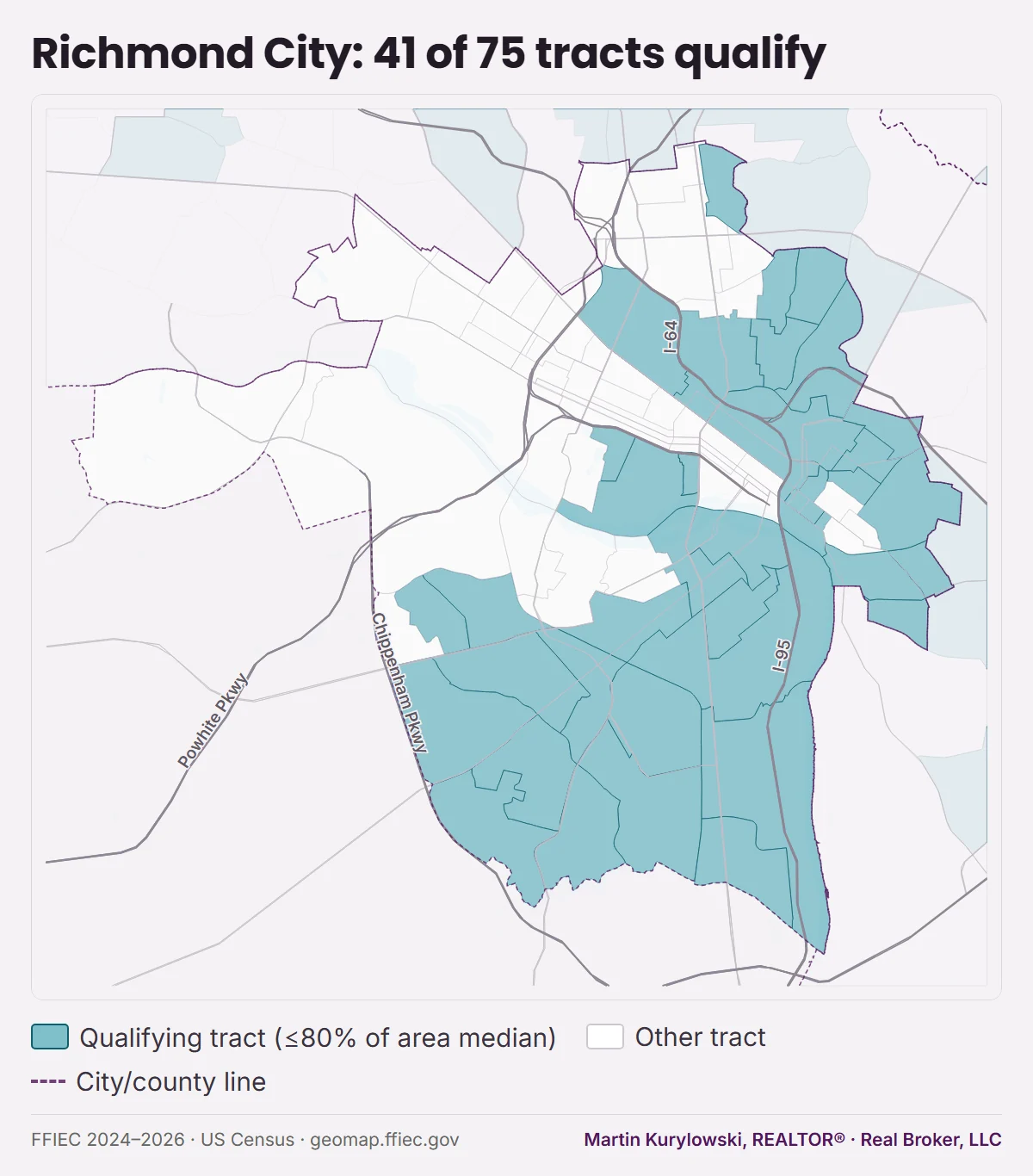
Richmond City's qualifying tracts reach across the North Side, East End and Southside, and several stop partway through neighborhoods. In all, about 31,900 of the city's 62,100 residential parcels sit in a qualifying tract.
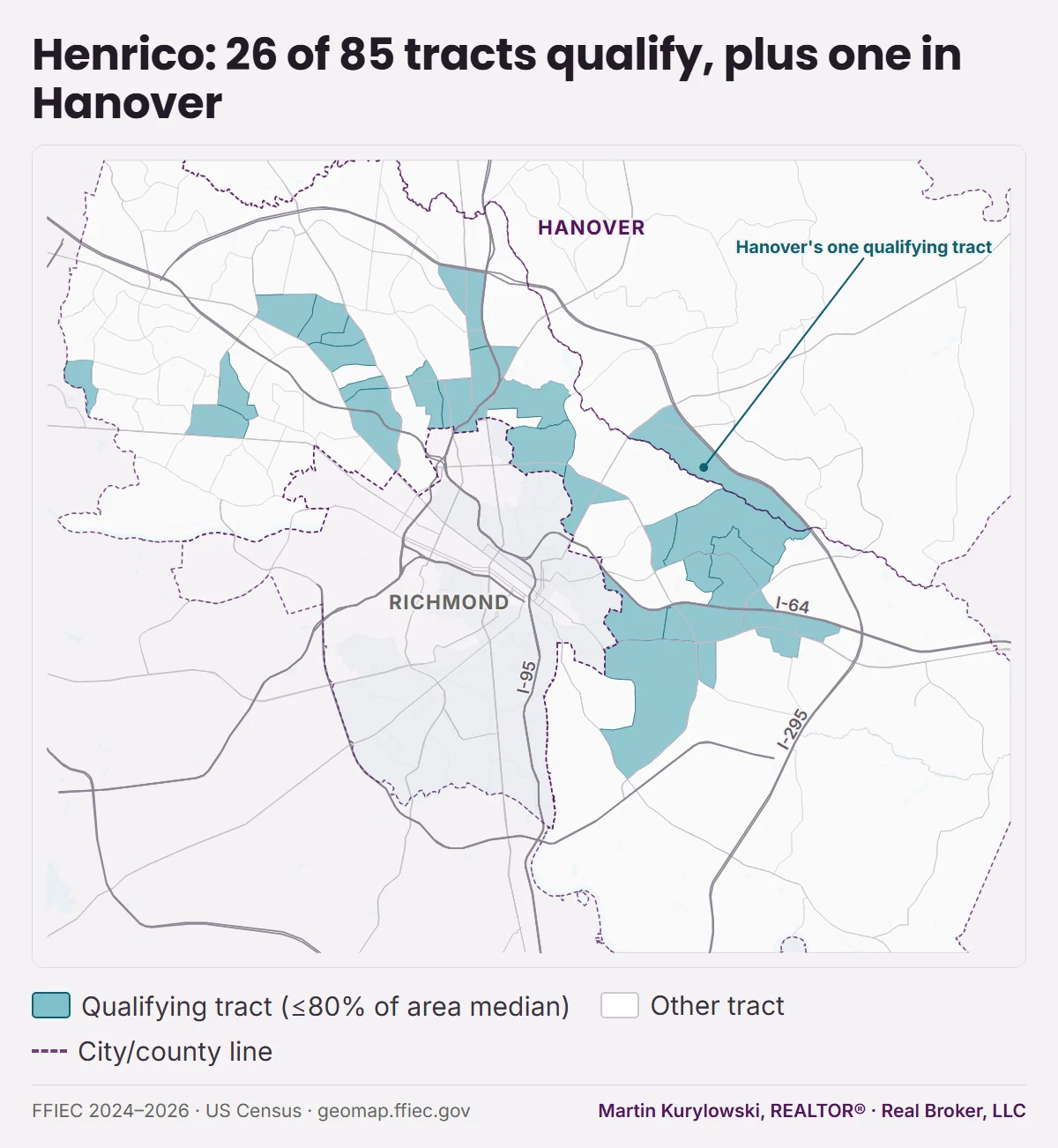
Henrico's qualifying tracts are scattered from the East End to the West End. Hanover has just one, in Mechanicsville between I-295 and the Chickahominy River (ZIP 23111).
Three things that surprise most buyers
1. ZIP codes don't follow tract lines
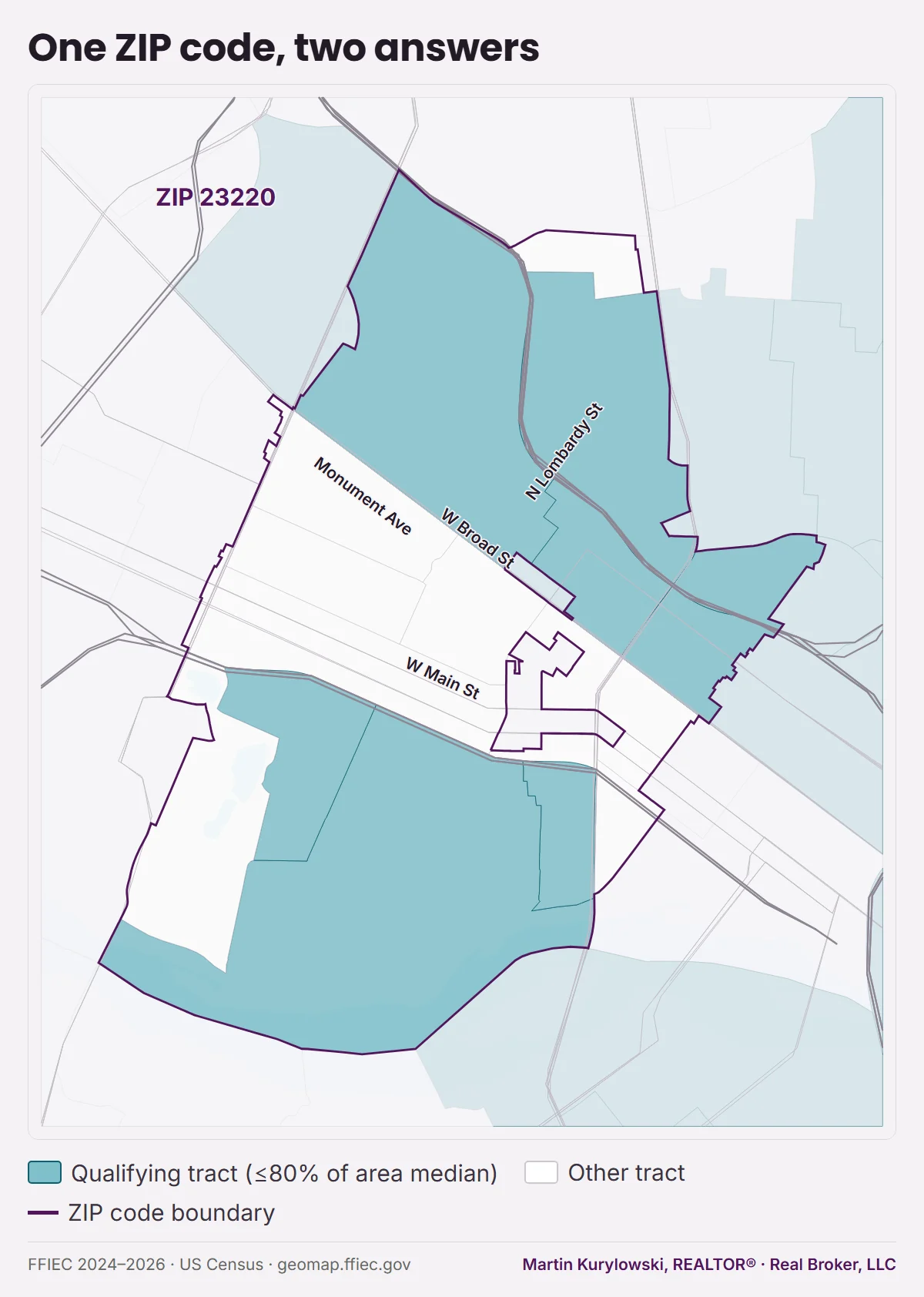
In ZIP 23220, about 47% of the 8,553 residential parcels sit in a qualifying tract and the rest don't. Residential parcels from City of Richmond address points and land use.
One ZIP code can hold both qualifying and non-qualifying tracts, sometimes on opposite sides of the same street. Some city ZIPs are almost entirely in qualifying tracts, and some have none. Searching by ZIP code alone will pull in plenty of homes that don't qualify.
2. Neighborhood names don't follow tract lines either
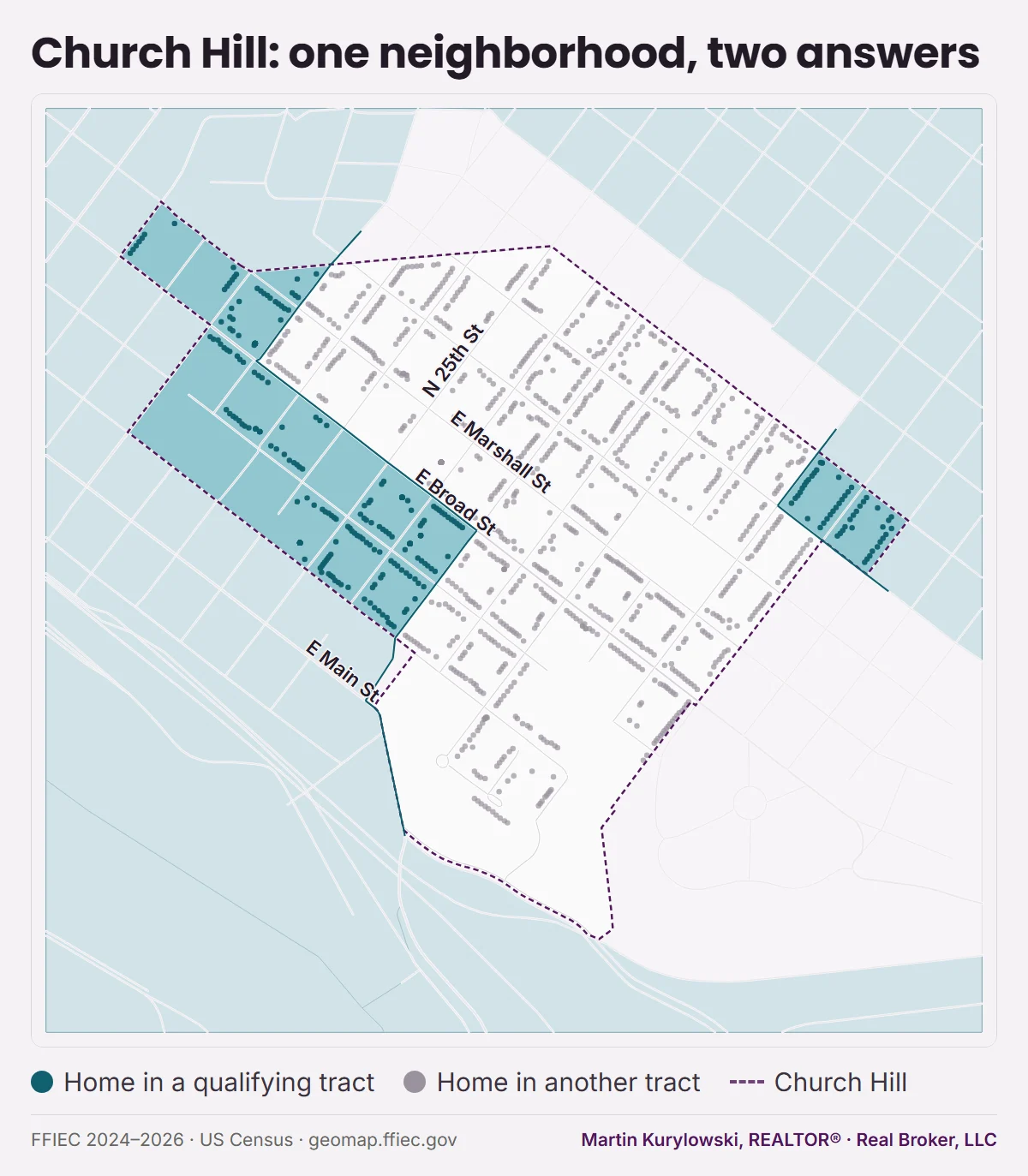
285 of Church Hill's 1,321 residential parcels (about 22%) are in a qualifying tract. Through much of the neighborhood, the line follows E Broad St. Each dot is one residential parcel.
Some neighborhoods sit entirely inside qualifying tracts, some entirely outside, and some are split. Church Hill is split: two homes in the same neighborhood, a few blocks apart, can get different answers.
3. The qualifying list isn't what people guess
Qualifying tracts show up in parts of the region many buyers wouldn't expect, and some areas people assume qualify don't. You can't tell by driving through. Look the address up.
How the tract should shape your search
If you're above the metro median income, here's how I'd set up a NACA search:
- Get your bracket from your counselor first. If you're at or below 100%, the tract doesn't affect your rate, so search on everything else that matters to you.
- Start from the map, not from a ZIP code. I keep maps of every qualifying tract in Richmond, Henrico and Hanover. We set up your search to cover the areas you actually want, and I check every home before you see it.
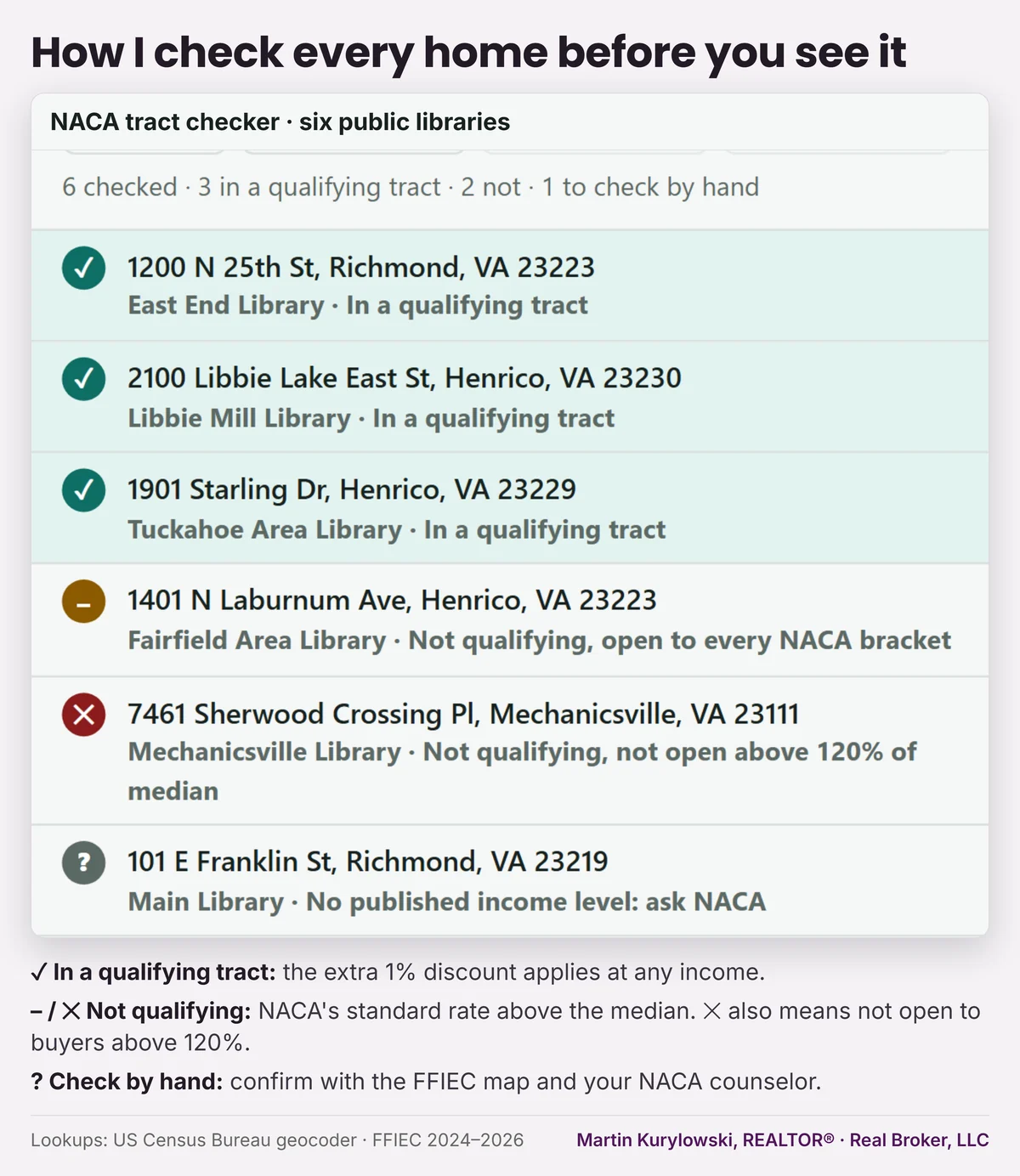
My tract checker looks each address up with the US Census Bureau and the current FFIEC tract levels, one at a time or a whole page of search results at once. Example: six public libraries.
- Check every address, every time. Before you fall for a house, look up its exact address. You can use my free tract check, or the FFIEC's own geocoder at geomap.ffiec.gov, which NACA's guidelines point to.
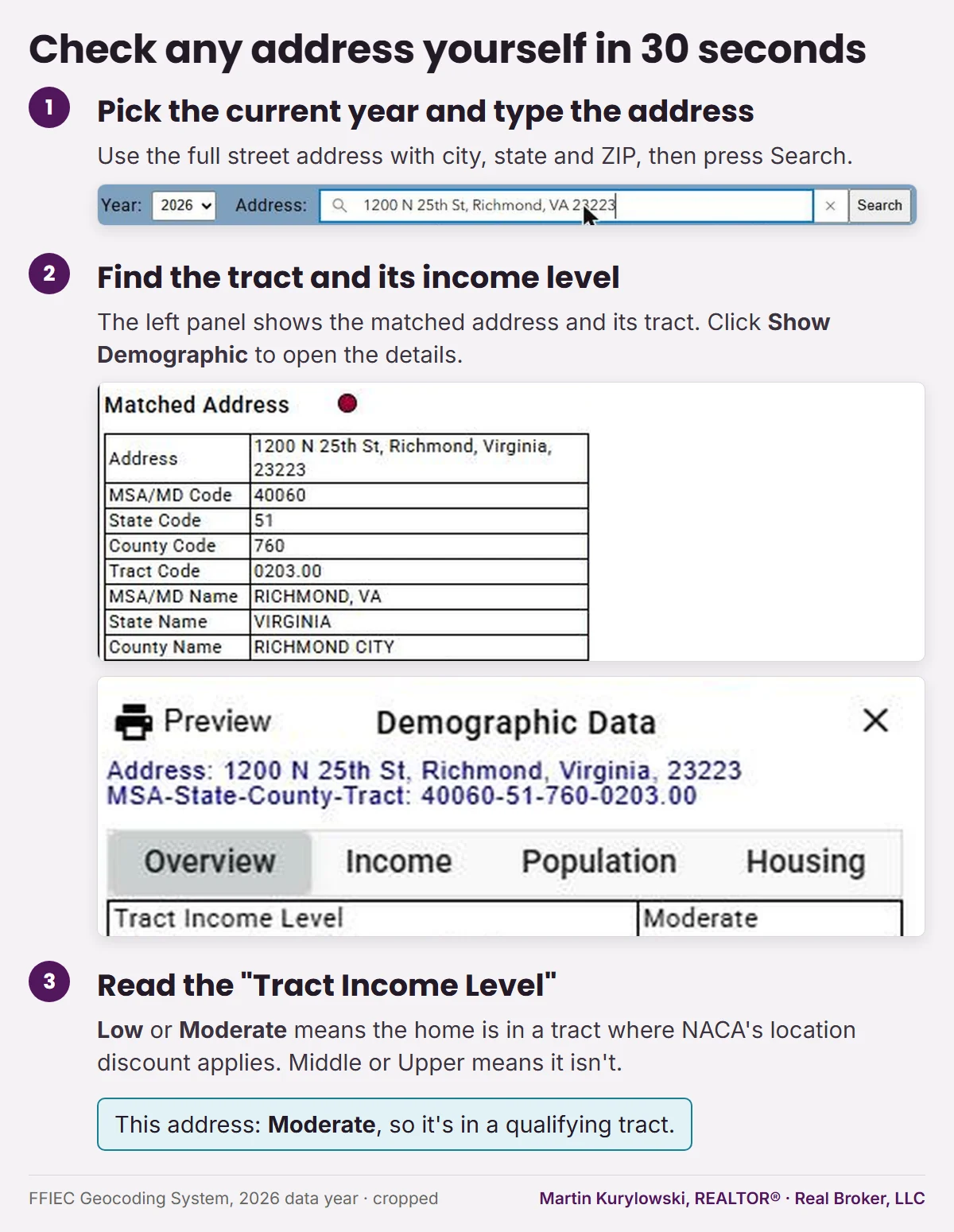
On the FFIEC geocoder, a "Tract Income Level" of Low or Moderate means the home is in a qualifying tract. Example: the East End Library.
- Weigh it, don't obsess over it. The tract affects your rate, not whether you can buy with NACA (unless you're above 120%). A home outside a qualifying tract can still be the right home, at NACA's standard rate. That trade-off is your call, and I'll show you both sides of it.
- Confirm with NACA before the offer. Your counselor has the final word on how a specific property affects your terms.
Things that can trip you up
- Tract levels change. FFIEC updates the levels when new Census survey data comes out, so a tract can move in or out of the qualifying list. A list from a few years ago may be wrong today.
- The edge of a tract is a real edge.
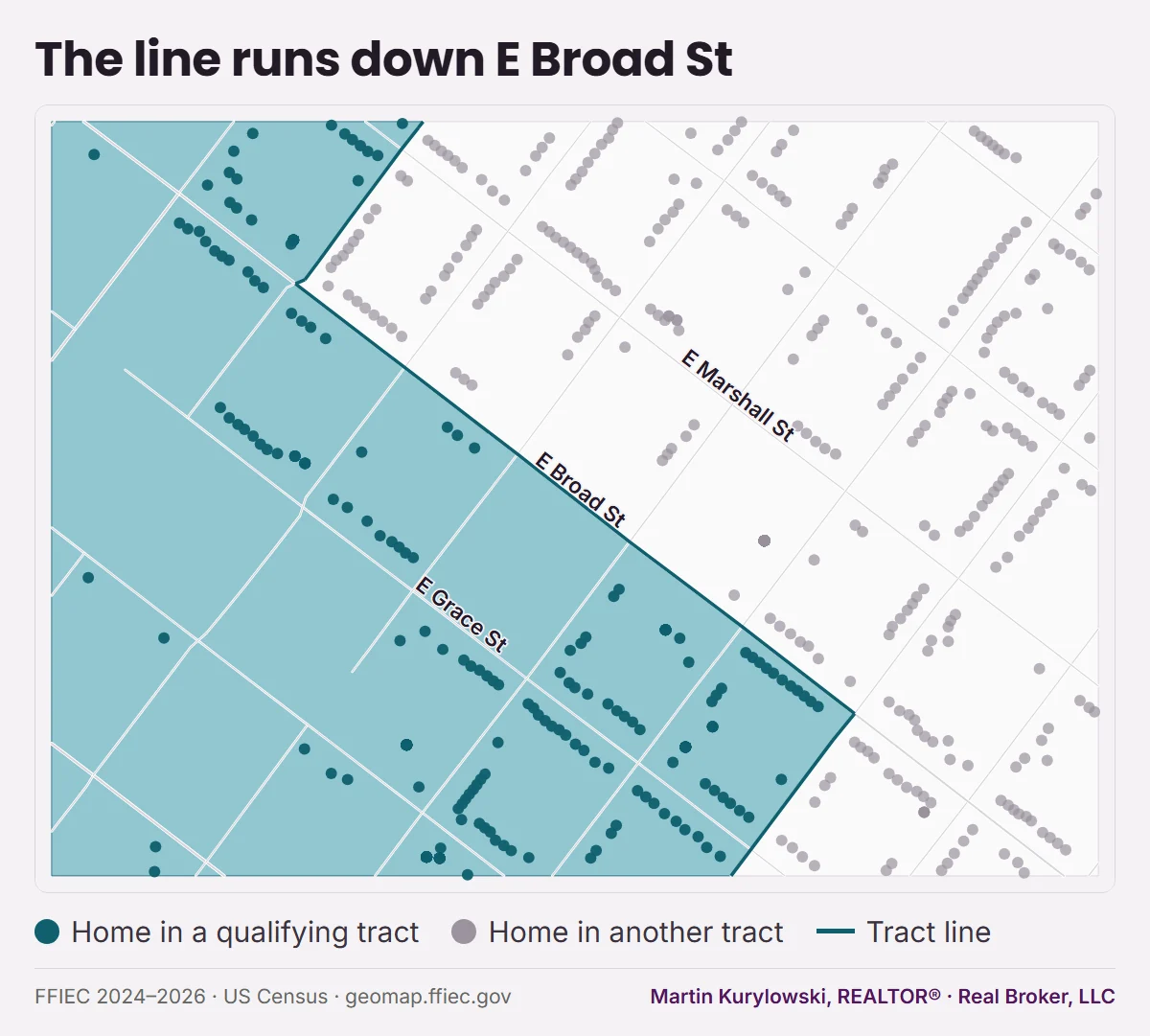
Homes facing each other across E Broad St are in different tracts and can get different NACA answers. A geocoder can also put an address on the wrong side of a boundary that runs down the middle of a street. That's why the official FFIEC lookup and your counselor are the final check.
- New construction can be hard to look up. Brand-new addresses sometimes aren't in the geocoders yet. Use the lot's location or the county's parcel record.
- The rule is about financing only. A tract's income level tells you how NACA prices your loan. It says nothing about a neighborhood or the people who live there, and it shouldn't be the only thing driving where you live.
The bottom line
If your income is above the metro median, where you buy can change your NACA rate, and above 120% it changes where you can buy at all. Ask your counselor for your bracket, check every address against the current FFIEC tract levels, and work with an agent who knows where the lines fall.
Check an address now, or ask me for the tract maps for the areas you're considering. I'm glad to walk through them with you.
Tract levels are from FFIEC's 2024–2026 census tract data. NACA's income brackets are from its homebuyer workshop materials and can change. Confirm your eligibility and terms with your NACA counselor. Homes outside qualifying tracts are still eligible for NACA at its standard rate.